Off-Page SEO & Authority Services in Saudi Arabia
Rankings don’t just come from what’s on your site, they come from how much the rest of the web trusts it. We build that trust the right way: earned links, digital PR, and a clean authority profile that tells Google your brand is credible.
You can have the best content in your market and still watch weaker competitors outrank you. When that happens, the gap is almost always off the page. Google doesn’t just read your website, it reads what the wider web says about you, and that’s what convinces it your business is an authority worth ranking. If your backlink profile is thin, or worse, built on the cheap links a previous agency bought by the hundred, that’s not helping you, it’s a liability that can quietly hold you back or trigger a penalty. Meanwhile the competitors above you usually aren’t better; they’re just more trusted in Google’s eyes.
That’s what we fix. Our off-page SEO services in Saudi Arabia build genuine authority through a white-hat system, real editorial links earned from relevant sites, digital PR that puts your brand in front of the media, and consistent signals that validate you as a real, credible entity. Message us for a free authority audit: we’ll review your backlink profile, anchor-text health, and brand-mention gaps, and show you exactly where your authority stands and what’s holding it back.
Deep-Tier Link Building & Link Equity Flow
Not all links are worth having. A single editorial link from a respected, relevant site can move rankings that a hundred cheap directory links never will and those hundred cheap links can actively drag you down. The difference isn’t quantity; it’s the equity a link carries and whether it looks natural to Google. As a professional link-building agency, our job isn’t to add links to a counter; it’s to build a backlink profile that earns trust and holds up to scrutiny, including Google’s next algorithm update.
Link Earning, Not Link Buying
There’s a fast way to get links and a right way, and they lead to very different places. The fast way, private blog networks (PBNs), automated link tools, paid link packages, and low-tier forum and comment drops, is exactly what Google’s algorithms and manual reviewers are trained to catch. Sites built on these don’t just plateau; they risk a manual action or an algorithmic hit that can wipe out rankings overnight, and cleaning up a toxic profile costs far more than doing it properly the first time.
We don’t buy links; we earn them. That means real outreach to real websites in your niche, ones with genuine traffic and topical relevance to your business and earning a place in their content because it belongs there, not because money changed hands. It’s slower, and it’s relationship-driven rather than transactional, but it’s the only kind of link building that compounds instead of becoming a liability you have to undo later.
Equity Flow: Relevancy, Power & Velocity
A link’s value comes down to a few things, and we weigh each before pursuing one. Relevance, a link from a site in or near your industry carries far more weight than one from an unrelated page. Power, measured through signals like Domain Rating (DR) and the balance of Trust Flow to Citation Flow, alongside whether the linking page itself has real organic traffic, not just a strong domain sitting on a weak page. And the profile’s naturalness, a healthy mix of follow and no-follow links, with sponsored and UGC attributes used correctly, because a profile that’s 100% follow-links looks manufactured to Google.
There’s also timing. Links should accumulate at a natural pace; a sudden spike of new referring domains is one of the clearest unnatural-pattern signals there is. We manage link velocity so your profile grows steadily and credibly, the way a genuinely popular site would.
Anchor Text Architecture
Anchor text, the clickable words a link is wrapped in, is one of the most misused parts of off-page SEO, and one of the fastest ways to get penalised. If too many links use the exact keyword you want to rank for, Google reads it as manipulation, and post-core-updates that over-optimization is punished harder than ever. A natural profile is mostly your brand name and plain URLs, with keyword-rich anchors used sparingly.
As a working guide, a healthy distribution looks roughly like this:
| Anchor type | Healthy range | Example |
| Branded | ~40–50% | “Diproot SEO” |
| Naked URL | ~15–20% | “diprootseoo.com” |
| Generic | ~10–15% | “click here,” “read more” |
| Partial-match | ~10–15% | “SEO services in Jeddah” |
| Exact-match | ≤5% | “off-page SEO Saudi Arabia |
We monitor and shape this distribution deliberately as your profile grows, keeping exact-match anchors low and your overall profile in the range that reads as earned rather than engineered.
Modern Digital PR & Brand Authority
The strongest links can’t be bought at any price; they’re earned by being worth writing about. Digital PR is where SEO and traditional public relations meet: instead of asking a site for a link, you give the media something genuinely worth covering, and the links and mentions follow. It’s how brands earn placements on the kind of high-authority news sites that no link package can reach, and it’s one of the clearest ways to prove to Google that a real, credible organization stands behind your website. Our corporate digital PR campaigns are built to earn that level of recognition, the authority that separates a trusted brand from just another site.
High-Tier Editorial Acquisition
something worth their attention, a piece of original research, a data study on your market, a genuinely useful industry insight, or a real company milestone that has news value. Then it’s outreach: pitching the right journalists and editors at publications that matter, in a way that gives them a reason to cover it.
For the Saudi market, that means targeting respected regional outlets, the likes of Arab News, Saudi Gazette, Argaam, and Sabq, where a mention carries real weight with both readers and search engines. A straight word on expectations, because this space attracts a lot of empty promises: no one can guarantee a placement in a specific publication, editorial coverage is earned on merit, and any agency promising a guaranteed spot in a named outlet isn’t being honest with you. What we do is build genuinely newsworthy assets and pursue the right placements persistently, which is what actually earns high-tier coverage. And when a strong asset lands, we syndicate it, one well-made study or insight can be pitched across multiple outlets, multiplying the reach and the authority from a single piece of work.
Unlinked Brand Mentions & Knowledge-Graph Validation
Here’s something most link-focused agencies overlook entirely: Google reads mentions of your brand even when they aren’t hyperlinks. When trusted sites, news outlets, and industry publications name your business, linked or unlinked, those mentions act as trust signals that help validate your brand as a real entity in Google’s Knowledge Graph. Authority isn’t only about who links to you; it’s about who talks about you, and how consistently.
So we treat brand mentions as part of the authority picture, not an afterthought. That means finding places where your business is already mentioned without a link and working to convert those into links where it makes sense, and making sure your brand is named and described consistently everywhere it appears, so Google connects every mention to the same entity. Over time this compounds your E-E-A-T in a way raw link count alone can’t, because a brand the web genuinely talks about reads as more trustworthy than one that simply accumulated links.
Citations-as-Authority & Entity Validation
Citations, the places your business is listed across the web, do more than help people find you. Every consistent listing is a small vote of confirmation that your business is real, established, and exactly who it says it is. Google cross-references these listings to validate your brand as a legitimate entity, and that validation feeds directly into how much it trusts your site overall. Our local citation building services treat citations as part of your authority foundation: not a box to tick, but a network of consistent signals that tells search engines your business is credible and coherent everywhere it appears.
(Worth being clear about scope: this is about citations as a trust and authority signal for your brand as a whole. If you’re focused on ranking in Google Maps and being found by nearby customers, that’s a different job, we cover local citations for Map Pack visibility on our Local SEO page.)
NAP Consistency as a Trust Signal
Your NAP, Name, Address, Phone number, is the core data Google uses to confirm you’re one consistent business. When those details match perfectly across every listing, it reads as a clear, machine-readable signal of legitimacy. When they don’t, an old phone number on one directory, a slightly different business name on another, a former address somewhere else, each mismatch introduces doubt, and doubt erodes trust. These inconsistencies pile up quietly, especially for businesses that have moved, rebranded, or had listings created at different times over the years.
The fix is order, not volume. Before adding anything new, we audit and clean up the inconsistent and duplicate listings already out there, because expanding on top of bad data just spreads the problem. Then we focus on trusted, relevant directories rather than blasting your name across hundreds of low-quality ones, which does nothing for authority and can look spammy. A tight, consistent, credible citation footprint beats a large messy one every time.
Schema-Backed Citation & Entity Network
Consistency across listings is stronger when your own website confirms it in a language machines read directly. Using Organization schema and sameAs markup, we connect your website to your official profiles, directories, and mentions, explicitly telling Google that all of these represent the same single entity. Instead of leaving search engines to infer the connections, you’re stating them outright, which tightens the whole validation picture.
For a bilingual business, this matters even more. Your Arabic and English presences need to be recognised as one business, not two unrelated ones, so we keep your entity details consistent across both languages and reinforce that connection in your structured data, a part of important technical SEO. The result is a clean, coherent entity that Google, and increasingly AI systems, can understand and trust without ambiguity.
The Bilingual Authority Advantage
Most global link-building agencies build authority in one language: English. But in Saudi Arabia, a real authority profile has to work in both. Arabic-language links and mentions from respected regional sites signal relevance to Google in a way an all-English profile never can and they reach the audience actually searching in Arabic.
This is where a bilingual team has a genuine edge. We build trusted regional backlinks across both Arabic and English sources, understand the GCC media and editorial landscape, and know how to earn coverage in Arabic contexts rather than translating an English pitch and hoping it lands. The result is a dual-language authority profile that reads as native to the Saudi market, something an agency operating only in English simply can’t replicate.
How We Measure Authority?
Authority isn’t a vague promise, it’s measurable, and you should expect to see it tracked. Every month, we report on the signals that actually reflect whether your off-page work is building real trust:
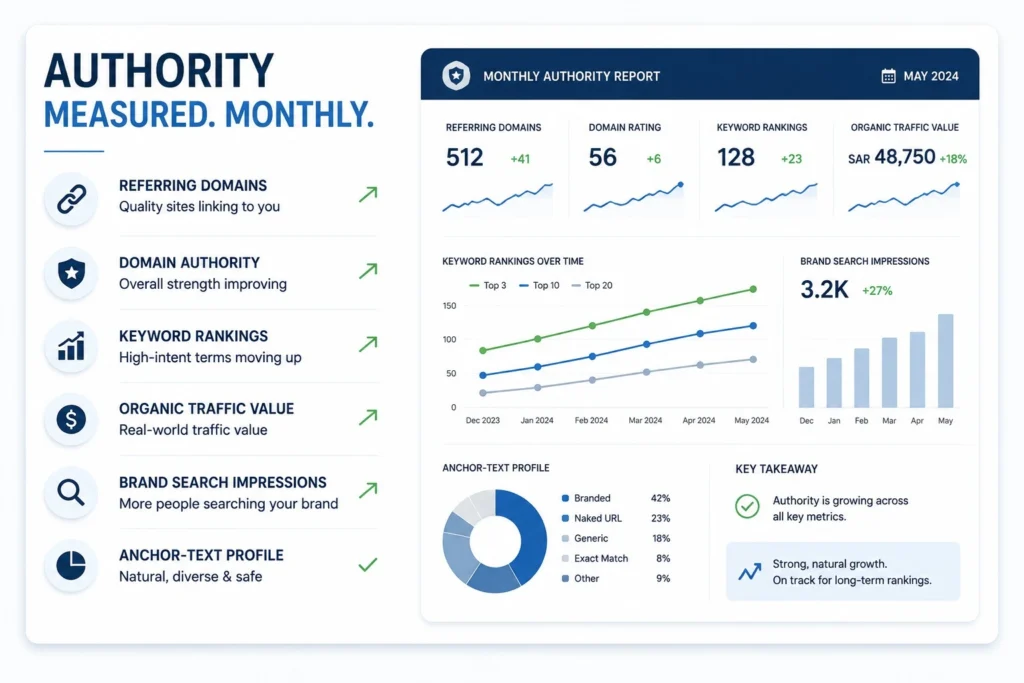
You’ll always know where your authority stands and what moved it, no black-box reporting, no taking our word for it.
Off-Page SEO: Frequently Asked Questions
If your rankings have stalled, or your backlink profile is more liability than asset, an authority audit is the fastest way to find out where you stand. You can check our work samples or message us for a free authority audit, we’ll review your backlink profile, anchor-text health, and brand-mention gaps, then show you exactly what’s holding your authority back and how to build it the right way. No pressure, no obligation.