Answer Engine Optimization (AEO) & GEO Services in Saudi Arabia
Answer Engine Optimization is the work of getting your brand cited inside AI answers, ChatGPT, Perplexity, Claude, and Google’s AI Overviews. As an LLM optimization agency, we build the signals that make those engines name you, so you earn visibility and referral traffic from the way people now actually search.
Search is quietly changing under everyone’s feet. More people now ask ChatGPT or Perplexity a question, or read Google’s AI Overview, and get their answer without clicking a single website. That creates a problem no amount of traditional SEO solves: you can rank number one on Google and still be completely absent from the AI answer your customer actually reads. If the model doesn’t mention you, you don’t exist to them and your competitor who is mentioned wins the customer before you ever had a chance.
Being invisible inside AI answers is the new version of being on page two. That’s the gap we close with SEO and local SEO. We engineer the signals AI systems use to decide who to cite, clear, extractable content, a validated brand entity, and consensus about you across the wider web, to maximize how often these engines reference you.
Message us for a free AI visibility audit: we’ll check whether ChatGPT, Perplexity, and Google’s AI Overviews currently mention your brand, where you’re being left out, and what it takes to change that.
What AEO and GEO Actually Are (SEO vs AEO vs GEO)?
AEO and GEO are two related approaches to the same shift: making sure your brand shows up when people get answers from AI instead of search results. Answer Engine Optimization (AEO) focuses on getting your content cited as the source behind an AI answer. Generative Engine Optimization (GEO) focuses on shaping how generative AI systems represent and recommend your brand within the answers they write. Traditional SEO gets you ranked on a page of links; AEO and GEO get you into the answer itself.
The difference comes down to how each system finds information. Traditional search matches your page to a query and lists it. AI engines work differently, they break content into passages, convert them into mathematical representations (vector search), and pull the passages that best match a user’s question in semantic context, then synthesize an answer from the most extractable, trustworthy sources. So ranking is no longer the goal; being the clearest, most citable source an LLM can pull from is.
Here’s how the three compare:
| Traditional SEO | AEO | GEO |
| Rank in the list of links | Get cited as a source in AI answers | Shape how AI describes and recommends you |
| Position #1 on Google | Your brand named in the answer | AI recommends you as a top option |
| Search results page | ChatGPT, Perplexity, AI Overviews | Generative AI responses |
| Keywords, links, on-page | Extractable content, entity trust | Consensus and sentiment across the web |
| Rankings, organic traffic | Citation frequency, AI referrals | Share of model, answer sentiment |
For most brands, these aren’t a replacement for SEO, they’re the next layer on top of it. You still want to rank; you now also want to be the source the AI cites when it answers instead of listing. The work overlaps with good SEO, but it’s aimed at a different destination.
How AI Engines Choose What to Cite?
AI engines cite sources they can extract cleanly and corroborate elsewhere. When someone asks a question, the system retrieves the passages most relevant to it, checks whether the information is trustworthy and consistent across sources, and builds its answer from the ones it can pull and rely on. So getting cited comes down to three things: content a machine can extract, a brand it can verify, and information worth including. The rest of this section is how each works.
Retrieval-Augmented Generation & Vector Search
Most AI answers are built through Retrieval-Augmented Generation (RAG), the model doesn’t answer from memory alone; it retrieves relevant, current content and generates its answer from that. To find the right content, it uses vector search: your text is broken into passages and converted into mathematical representations of meaning, and when a question comes in, the system matches it to the passages whose meaning is closest.
The practical consequence is that AI reads your content in chunks, not as a whole page. A passage has to make sense on its own, because it may be pulled out of your page entirely and dropped into an answer with no surrounding context. Content built as clear, self-contained blocks that each answer something directly is far more likely to be retrieved and cited than the same information buried in a long, meandering paragraph. Writing for retrieval means writing so any single passage can stand alone and still be true and useful.
Entity Validation & the Knowledge Graph
AI systems don’t just retrieve text; they need to trust the brand behind it. That trust is built through entity validation, confirming your business is a real, consistent entity by cross-referencing what your site says against what the rest of the web says. When your name, description, services, and key facts are consistent everywhere and corroborated by independent sources, you become a well-defined node in Google’s Knowledge Graph and a brand AI models can reference with confidence.
When they’re inconsistent, different descriptions, conflicting details, thin presence, the model can’t confidently say who you are, so it leaves you out and cites a clearer competitor instead. A validated entity is often the difference between being mentioned and being skipped. This is why AEO isn’t only on-page work; it depends on consistent, corroborated signals across your whole web presence.
Information Gain as a Citation Driver
AI engines have already absorbed the obvious, widely-repeated information on any topic. What earns a citation is information gain, content that adds something the corpus doesn’t already have. Original data, first-hand experience, specific figures, a genuinely useful angle, or an answer to a question no one else has answered well: these give a model a reason to reach for your source specifically, because you’re saying something it can’t get from the hundred pages that all repeat each other.
This is where generic, AI-generated content fails completely. It’s built from what already exists, so it contributes nothing new and gets passed over. Content grounded in real expertise and original insight is disproportionately what gets cited, which is exactly why the human, experience-first approach isn’t just a quality preference, it’s an AEO advantage.
On-Site AEO: Making Your Content Machine-Extractable
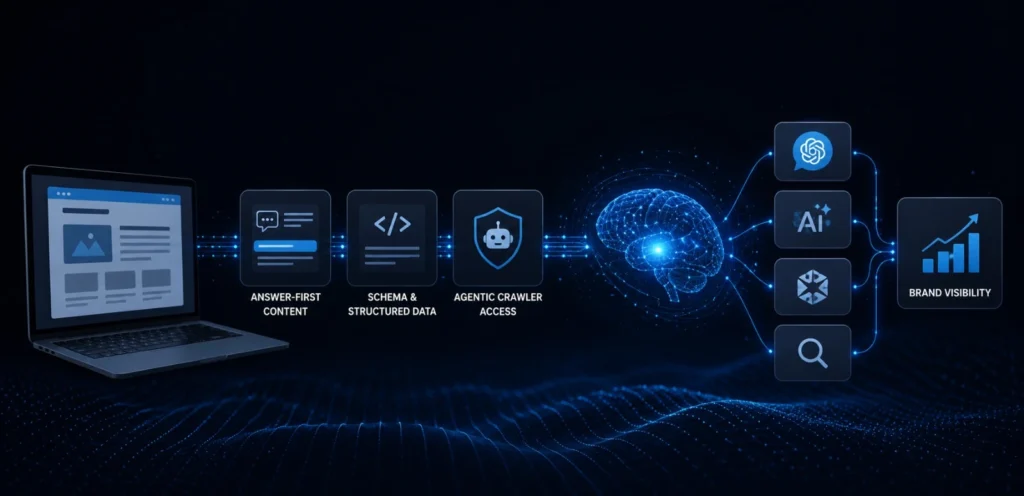
On-site AEO is the engineering that lets AI systems read, pull, and cite your content accurately. It comes down to three things: writing content in blocks a machine can extract cleanly, marking it up so systems understand exactly what it is, and making sure AI crawlers are allowed to access it in the first place. Get these right and your content becomes easy to quote; get them wrong and even great content stays invisible to AI.
Answer-First Content & Extractable Blocks
The single most important on-site technique is answering the question immediately. AI systems favor short, self-contained passages, roughly 40 to 60 words, that state an answer directly, because those are the easiest to lift cleanly into a generated response. Content that buries its answer under three paragraphs of build-up rarely gets extracted, no matter how good it is.
So we structure content the way AI reads it: lead each key section with a direct, standalone answer, then expand underneath. We frame content around the actual questions your audience asks, use clear headings that state what each section covers in literal terms, and format with the lists, definitions, and structure that make a passage easy to pull. The bonus is that the same structure that helps AI extract your content also makes it faster and clearer for human readers, you never trade one for the other.
Schema & Structured Data (JSON-LD)
Structured data tells AI systems exactly what your content is, in a language built for machines. Using JSON-LD schema, FAQPage, Organization, and Product markup, you label your content explicitly: this is a question and its answer, this is the business and its details, this is a product and its attributes. Instead of leaving an AI to infer what it’s reading, you state it directly, which reduces ambiguity and strengthens how confidently a system can understand and cite you.
Schema also reinforces your brand as a clear entity, connecting your content, business details, and profiles into one coherent, machine-readable picture. The detailed implementation, building a connected schema graph, validating it, avoiding conflicting markup, is technical work we cover on our Technical SEO page; for AEO, the point is that clean structured data is one of the most direct ways to make your content legible to AI.
Agentic Crawler Access (robots.txt / llms.txt)
None of this matters if AI crawlers can’t reach your content and this is the step almost everyone misses. AI engines use their own crawlers to read the web (GPTBot for ChatGPT, ClaudeBot, PerplexityBot, and Google-Extended among them), and your site’s access rules decide which ones get in. Many sites are unknowingly blocking the exact crawlers they’d want citing them, while others have never made a deliberate decision either way.
We audit and configure this access properly through your robots.txt (and llms.txt, the emerging standard for guiding AI systems), so the engines you want to be visible in can actually read your content. This is also a genuine business decision, not just a technical toggle: some brands want maximum AI visibility and open the doors wide; others want to protect certain content. We help you make that call deliberately and set it up to match, rather than leaving your AI visibility to a default setting nobody chose.
Off-Site AEO: Building LLM Consensus
AI systems form their view of your brand from the whole web, not just your website. They synthesize what many independent sources say about you, and the consensus across those sources shapes how and whether, you get described and recommended. So a big part of AEO happens off your own site: making sure the wider web says the right, consistent things about your brand.
Third-Party & UGC Signals (Reddit, G2, Wikipedia, datasets)
Much of what AI models “know” about brands comes from user-generated content and independent platforms, Reddit threads, G2 reviews, Wikipedia, industry directories, and public datasets. When these sources consistently describe your business accurately and positively, that consensus becomes what the AI repeats. When they’re silent or contradictory, the model has nothing solid to draw on. We help build a genuine, accurate presence across the third-party sources that feed AI consensus, never faked, because manufactured signals are exactly what these systems are learning to discount.
Digital PR for Entity Corroboration
The more trusted, independent sources confirm who you are and what you do, the more confidently an AI can cite you. Coverage and mentions in respected publications corroborate your brand as a real, credible entity, reinforcing the same picture your website presents. The detailed digital-PR work behind this lives on our [Off-Page SEO page]; for AEO, the point is that trusted external validation is a direct input into whether AI systems trust and reference you.
Review & Sentiment Signals
AI doesn’t just note that you’re mentioned, it reads how you’re described. The sentiment across your reviews and mentions feeds directly into how an AI characterises your brand, so a business consistently described as reliable and well-regarded gets represented that way in AI answers. We help you build genuine review strength and positive sentiment across the platforms these systems read, so the story the web tells about you is one worth citing.
Answer Engine Optimization: Frequently Asked Questions
Right now, your customers are asking ChatGPT, Perplexity, and Google’s AI Overviews about what you offer and either your brand comes up, or a competitor does. Message us for a free AI visibility audit: we’ll check whether these engines currently mention you, where you’re being left out, and what it takes to become the answer they cite. No pressure, no obligation.