Technical SEO Services in Saudi Arabia That Fix What’s Holding Your Site Back
Great content can’t rank on a broken foundation. We fix the technical issues, slow load times, indexing problems, and messy site structure that quietly keep WordPress and e-commerce sites in Saudi Arabia off the first page.
Most site owners find out something is technically wrong the slow way. You publish good content, build a decent-looking website, and the rankings still don’t come. Pages sit unindexed for weeks, so Google never shows them at all. The site takes too long to load on a phone, and visitors leave before it finishes, especially on Arabic pages, where fonts and right-to-left layout can shift the screen around as it loads.
Duplicate URLs, a messy structure, or a plugin quietly blocking search engines can undo months of effort, and none of it is visible from the front end. These aren’t content problems; they’re foundation problems, and no amount of writing fixes them.
That’s the work we do. Our technical SEO services in Saudi Arabia find and fix what’s slowing your site down and keeping it out of search, from Core Web Vitals and indexing to structure and schema, so the pages you’ve already built can finally rank.
Message us for a free technical audit, and we’ll show you exactly what’s broken beneath the surface.
Core Web Vitals & Site Speed Optimization
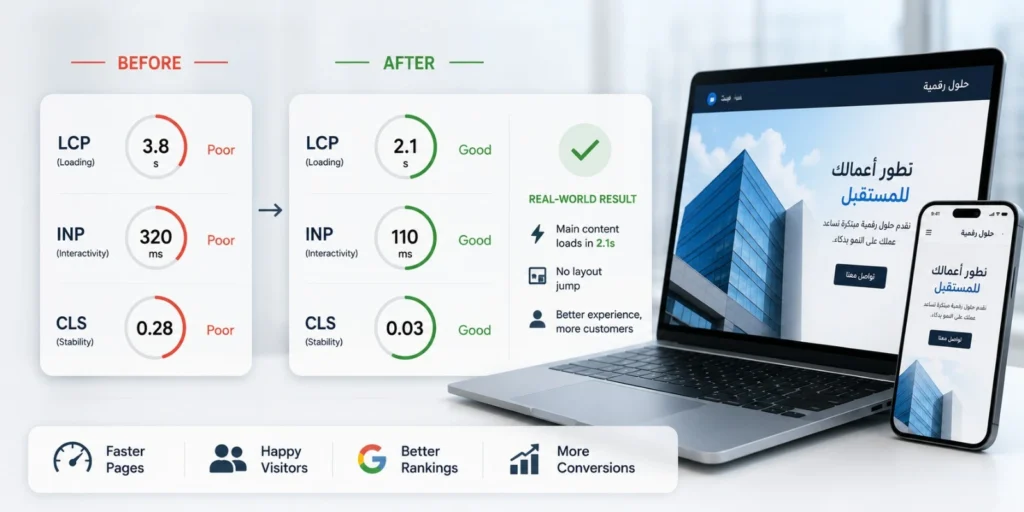
Google measures the actual experience people have on your site through three metrics it calls Core Web Vitals and they influence both your rankings and whether visitors stick around long enough to become customers. In plain terms: how fast the main content appears (Largest Contentful Paint), how quickly the page responds when someone taps or clicks (Interaction to Next Paint), and how much the layout jumps around while it loads (Cumulative Layout Shift). When any of these is poor, people feel it before they can name it, and they leave.
On WordPress, the causes are usually predictable, a heavy theme loading far more than it needs, a stack of plugins each adding scripts, large uncompressed images, no caching, and hosting that’s slow to respond in the first place. We work through each of these, and we test the way your visitors actually experience the site: on a phone, on a Saudi connection, in both Arabic and English. Our Core Web Vitals optimization isn’t a single plugin toggle; it’s methodical work across the whole loading chain
Speed & Largest Contentful Paint (LCP)
LCP is how long it takes for the biggest, most important element on the screen, usually your hero image or headline, to actually appear. Past about 2.5 seconds, it feels sluggish and people start leaving. The common culprits on WordPress are oversized images, render-blocking CSS and JavaScript loading before the content, and no caching layer. We compress and correctly size images (and serve modern formats like WebP), set up proper caching, defer what doesn’t need to load first, and address slow server response time (TTFB), often by moving to better hosting or a CDN with edge delivery closer to your users in the Kingdom. Website speed optimization in Saudi Arabia isn’t only about the code; it’s about how far your data has to travel to reach the person searching.
INP & Interactivity
Interaction to Next Paint measures how quickly your site reacts when someone actually does something, taps a menu, opens a filter, adds to cart. A page can look loaded but freeze for a moment when tapped, and that lag is what INP captures (it replaced the older FID metric in 2024). The usual cause is too much JavaScript running on the main thread, often from plugins doing work in the background. We identify what’s blocking responsiveness, reduce and defer non-essential scripts, and trim the plugin load so the site reacts the instant someone interacts with it.
Layout Stability & Arabic RTL/CLS
This is the one most sites and most agencies overlook, and it matters more on Arabic pages than almost anywhere. Cumulative Layout Shift measures how much the page moves around as it loads; you’ve felt it when you tap a button and the screen jumps, so you tap the wrong thing. It’s caused by images without set dimensions, content loading late, and critically for bilingual sites, web fonts swapping in after the page renders. Arabic web fonts are often heavier and load differently, and when they arrive late they can reflow right-to-left text and shift the whole layout. We fix this by reserving space for images and embeds, preloading key fonts, and handling Arabic font loading so your RTL pages stay visually stable from the first moment. For a bilingual Saudi site, getting this right is a real advantage, most competitors don’t even test for it.
Getting Your Pages Crawled and Indexed Properly
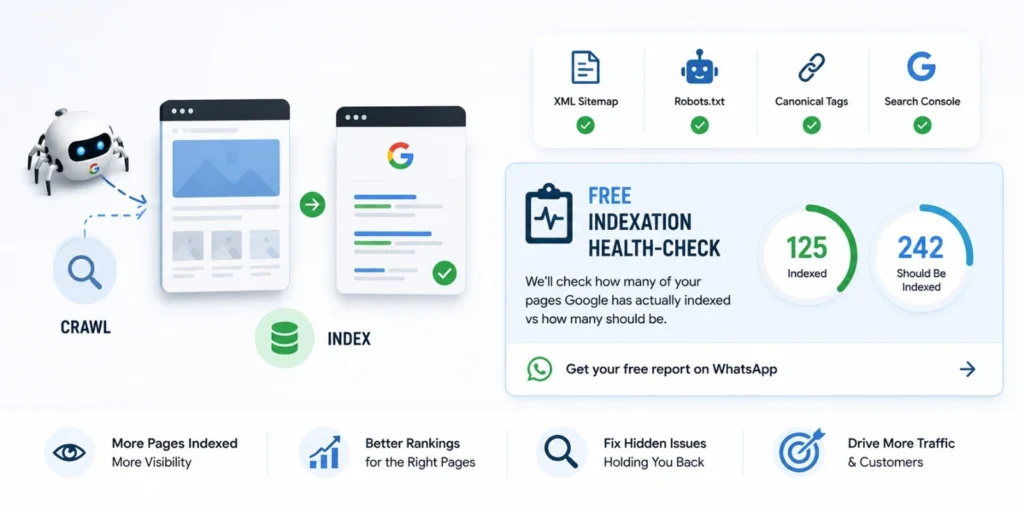
Before a page can rank, two things have to happen: Google has to crawl it (find and read it) and then index it (add it to the results it can show). It sounds automatic, but it often isn’t. Plenty of WordPress sites have pages that Google has never indexed, sitting live, fully written, and completely invisible in search. If you’ve ever wondered why a page you published months ago brings zero traffic, this is usually why.
A big part of solid WordPress technical SEO is making sure search engines can move through your site cleanly and understand which pages actually matter. That means a correct XML sitemap pointing Google to your real content, a robots.txt that isn’t accidentally blocking the wrong things, and canonical tags that tell Google which version of a page is the original when duplicates exist. We also check what Google has actually indexed using Search Console, not what you assume is indexed and fix the gap between the two.
For bilingual sites, there’s an extra layer: both your Arabic and English pages need clear crawl paths so each language tree gets discovered and indexed on its own. When that’s not set up properly, one language can end up largely invisible while the other ranks, a common and costly problem for Saudi sites running both.
Sitemaps, robots.txt & Canonicals
These three files and tags quietly control how search engines see your entire site, and small mistakes in them cause outsized damage. A sitemap listing old or redirected URLs wastes Google’s attention; a single wrong line in robots.txt can block an entire section from being crawled; and missing or incorrect canonical tags let duplicate versions of a page compete against each other and split their ranking strength. We make sure your sitemap reflects only the pages you want ranked, your robots.txt allows what it should and blocks what it shouldn’t, and your canonicals point cleanly to the right version, so Google spends its time on the pages that matter to you.
Fixing Thin, Duplicate & Orphan Pages
Not every page helps you, some quietly work against you. Thin pages with little real content, near-duplicate pages (a frequent side effect of WordPress tag and category archives), and orphan pages with no internal links pointing to them all dilute your site’s overall quality in Google’s eyes and waste crawl attention on URLs that will never rank. We audit your site for these, then decide the right fix for each, improve it, merge it, redirect it, or remove it and tighten your internal linking so every page that matters is properly connected. The result is a leaner, stronger site where your crawl budget goes to the content that earns rankings.
Schema Markup That Helps Google (and AI) Understand Your Site
Search engines and AI systems don’t read your page the way a person does. They rely on structured data, a hidden layer of code called schema markup, to understand exactly what your business is, what you offer, and how the pieces of your site relate. Without it, Google is guessing from your text. With it, you’re telling it directly, in a language it’s built to read.
Done properly, schema does two things. It makes you eligible for rich results, the extra detail that can appear in search, like star ratings, business information, and FAQs, which makes your listing stand out and earn more clicks. And increasingly, it helps AI-powered search understand and cite your business accurately, which matters more every month as people get answers from AI instead of scrolling links. Good schema markup in Saudi Arabia also has to work bilingually, so Google recognises your Arabic and English pages as one consistent business rather than two unrelated entities.
Structured data is also the technical groundwork for Answer Engine Optimization, being found inside AI answers. We cover that in depth on our AEO services page here. We make sure the underlying markup is built correctly.
Business & Product Schema (via Rank Math)
The foundation is getting your core business entity marked up correctly: Organization and Local Business schema carrying your name, address, phone, hours, and service areas, connected as a single graph rather than scattered, isolated tags, so search engines read your whole business as one clear entity. If you sell products, Product schema does the same for your catalogue: price, availability, and reviews, making items eligible for richer, more clickable listings. Since you’re on WordPress with Rank Math, much of this can be generated cleanly through it rather than hand-coded, and we configure it properly, validate it against Google’s Rich Results Test, and make sure two plugins aren’t quietly outputting conflicting markup, a common and messy problem that confuses Google.
Structured Data for AI Search Readability
Beyond rich results, structured data is becoming one of the clearest ways to make your site machine-readable for AI search. When your business, services, and answers are marked up cleanly and consistently, AI engines can understand and reference you with less ambiguity, and being the clear, well-structured source is what earns citations in AI answers. We build your markup so both traditional search and AI systems can parse who you are and what you do, and we keep your entity details consistent across Arabic and English so neither version confuses the systems reading them. It’s foundational work now, and it compounds as AI search keeps growing.
Bilingual & Mobile-First Technical SEO
Two realities shape technical SEO in Saudi Arabia more than anywhere else: most people search on their phones, and they search in two languages. Get either wrong at the technical level and you lose customers you never even see.
Start with mobile. Google indexes and ranks your site based on its mobile version, not the desktop one, so if your site is heavy, cramped, or awkward to use on a phone, that’s the version Google judges. Given how much of Saudi search happens on mobile, a site that’s merely fine on a phone is already behind. We make sure your site is genuinely mobile-first: fast, easy to tap and read, and free of the elements that frustrate people on smaller screens.
Then there’s the bilingual layer, and this is where many Saudi sites quietly break. If you run Arabic and English versions, Google needs hreflang tags to understand that they’re the same content in two languages, not duplicates competing with each other, so it serves the right version to the right searcher. Set this up wrong, and your Arabic pages can cannibalise your English ones, or the wrong language shows up in results. On top of that, the Arabic side has to render correctly: right-to-left layout that stays stable, fonts that load without shifting the page, and a mobile experience that works as smoothly in Arabic as in English. This bilingual and RTL technical health is exactly the layer most agencies skip and getting it right is a real edge for a business serious about reaching both of Saudi Arabia’s search audiences.
Technical SEO: Common Questions Answered
If your site is slow, missing from search, or just not ranking the way its content deserves, a technical audit is the fastest way to find out why. Message us for a free technical audit, we’ll check your Core Web Vitals, indexing, site structure, and schema, then show you exactly what’s broken beneath the surface and what it’ll take to fix it. No pressure, no obligation.